Posted by: Mali | June 27, 2012

S is for Salamanca

Before we went to Spain, I had spent hours researching the best itinerary, the towns and cities and villages and drives we shouldn’t miss, what to eat and drink and where to eat and drink it. Some destinations were a given – Granada, Barcelona, Madrid. Others were on our only-if-we-have-time list, due to their geography. One we deliberately decided to avoid – Valencia – because it would be overrun by America’s Cup contestants and fans, and because we were there to see Spain, not NZ fans wearing red socks. But some destinations were on our list simply because they were on the way to somewhere else. And Salamanca was one of those. It got three stars – worth the journey – in the Michelin Guide. But reading about it left me uninspired. It sounded like a university town, without much else to commend it other than some nice architecture. But the Michelin Guide has never really failed me, so I duly included Salamanca on our itinerary.

The day we drove in was bright and sunny and hot, the way Spain should be. We found an underground car park just outside the walls of the Old Town, and set off on foot to find accommodation.  We discovered that there was a medical conference, or some such thing, and the majority of hotels were booked. After traipsing across the compact city, we managed to find one hotel for the first night, and another outside the city walls for the following night. This is when the spot in my heart labelled Salamanca started to soften. I managed to book the first hotel entirely in Spanish, even self-correcting my Spanish grammar to the amusement of the receptionist who no doubt spoke fluent English. An even greater feat followed. I managed to book the room in another hotel for the following night entirely in my self-taught Spanish … on the telephone. (You have to understand my dislike of telephones to truly appreciate what a feat this was!)

So, settled in our modern hotel built around ancient Roman ruins, we set out to explore Salamanca. The stone of the city glowed a soft gold in the Spanish sun. The buildings were grand, but the decorations delicate, and they were beautiful day and night. We dutifully photographed the astronaut on the cathedral, amused at the suggestion that the builders in the 16th century were prescient. We drank in the beauty of the cathedral’s interior, and climbed to the top to look across the city from its viewing platforms. We enjoyed a long, lazy lunch with plenty of delicious Rioja on a narrow street just up from the university, noting the distinctive Spanish body shape as the students walked by.  We ended our days sitting in the Plaza Mayor, watching families and friends meeting at the end of the day, taking their paseos before the sun went down.  Protesting students kept the atmosphere lively.  And a conveniently located internet cafe enabled us to book our onward hotel in our next destination.

We walked, snapped photos, walked, snapped more photos, and walked. And by the end of our second day we agreed that, of all the cities we visited in Spain, Salamanca was probably our favourite.

Click on the thumbnails to get a better view of the delights of this lovely city.


Posted by: Mali | June 9, 2012

R is for Rovos Rail


“Look!” I cried, “ostrich!”  But by the time my husband looked up, and by the time I’d grabbed my camera, the ostriches were gone.   So my husband didn’t believe me.  “You’re imagining things again,” he said, referencing a trip to California and my desperate desire to see both sea otters and whales.  It took another 24 hours before I finally snapped an ostrich, and he believed me.

If my husband finally believed these blobs were ostriches, then you’d better too!

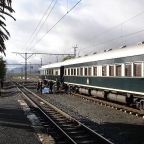
I’ve always loved the idea of train travel, growing up on a farm near the railway line, watching the trains whisking passengers to the cities north and south of us.  I’ve loved the mystery of the journey and the destination, and when we’re travelling, we often try to travel by train.  So on a trip to South Africa, we discovered there was a classic route from Pretoria in the High Veld, down to Cape Town on the Atlantic Ocean.  We could have taken a regular passenger train, or the luxurious and pricy Blue Train.  But we chose Rovos Rail.  An old, still luxurious train in the tradition of the great train journeys, Rovos Rail takes over two days and nights to make the journey, making its way leisurely through the amazing countryside of South Africa.

This photo has been stitched from about four smaller photos, hence the unnatural curve of the station

We left from the private Rovos station at Pretoria, where passengers were checked in at the large, comfortable departure lounge, treated with champagne as we admired the original steam train.  The President of the company welcomed us, then one by one we were called to board.

Our small cabin. Still it had an ensuite bathroom with separate shower and wardrobe, and was very cosy made up into a double bed. There’s nothing quite like waking up in the morning in a train and looking out onto a stark landscape as the sun rises.

We were in the simplest, least expensive of cabins, but in all other ways enjoyed the same experiences as the other passengers: the exhilaration of standing on the viewing deck watching Africa go by, meeting the other passengers keen on trains or travel or both; the elegant high tea served each afternoon in the observation car, with its large windows, comfortable armchairs, and stunning vistas.  Wherever I was on the train, I was spell-bound by the view through the windows.  The landscape changed constantly, from the flat plains to deserts to rivers and mountains.  I couldn’t read, or doze in our cabin.  I stared transfixed out the window, loving the barren scenery, excited at those first ostriches I’d seen on our trip, thrilled to capture some springboks on my camera.  There was no doubt that we were looking out at Africa, and it was thrilling to me.

Springboks

No surprises for guessing we’re in Africa

I was transfixed by the scenery rolling past.

A highlight of the trip was eating dinner in the dining car.  Each evening after freshening up in our cabins – and perhaps indulging in the champagne in the mini-bar as the sun set outside – chimes would ring (a staff member with a xylophone)  outside our doors, calling us to dinner.  Feeling as if we were on the Orient Express and sure to bump into Hercule Poirot, the men arrived in their jackets and ties and the ladies dressed up in their best (travel hardy) finery.  And as the train made its way through the expanse of South Africa, we were served a delicious meal and some really excellent local wines.  (I’ve read the occasional bad review of the food, but we had no problems with it, in fact, I was surprised how good it was coming from such a tiny kitchen.)  Intimate tables for two allowed for romance, and tables of four meant that we were sure to meet some new friends.

Old style romance, as we rocked and swayed our way across southern Africa

Our train left on Friday afternoon.  On Saturday morning, after a leisurely breakfast in the dining car, and after the train slowed to pass the lake full of 20,000 flamingoes, we arrived in Kimberley.  A tour of the Big Hole was arranged, a fascinating look at the beginning of South Africa’s diamond industry, and entry into the vault to see diamonds of all shapes and sizes.  Much to my husband’s relief, I showed little interest in the diamond stores where we could buy some glittery treats.  I’ve always said I’d rather travel than have diamonds (not being able to afford both), and our trip on Rovos Rail was living proof of this.

Tens of thousands of flamingoes. The train slowed for us to photograph them.

I was so excited to see flamingoes in the wild.

Clearly they don’t possess a need for personal space.

By Sunday morning a cold storm had blown through, with temperatures plummeting and the old train’s draughty corridors becoming chilly, though the rooms and public areas remained well heated.  So we decided to waive the option to take a 5 km walk across the Karoo (the dry desert plains) before arriving in Matjiesfontein, and stayed on the train eating a late, lazy breakfast.   We did disembark though to explore Matjiesfontein, a tiny village set in the midst of the Karoo that was once a popular resort.  We felt as if we were in the middle of nowhere.

Matijiesfontein stop – with hot towels and bubbles awaiting our return to the train

The train then made its way down to Cape Town.  The journey through the winelands revealed a startling beauty I had not expected in South Africa – the tips of the mountains tinged with new overnight snow, the vines lush and green, full of promise of depth of colour, full body, and plummy flavours.  A final lunch in the dining car, a final champagne in the observation car.  As we made our way into Cape Town, we realised we were re-entering the real world.  All too often the worst part of towns are on the train tracks, and our train made its way through the townships and slums of the poorest parts of Cape Town.  I felt uncomfortable then, standing on a luxury train holding my last glass of bubbly, watching groups of children playing in the dirt outside tin shacks.  But I remembered my early years on a farm not far from the main trunk line, and I remembered what a thrill it was to connect with people on a train, to wonder where they’d come from and where they were going, to wonder if they saw us.  So I waved at the children.  Excited, they jumped up and down and waved back, grinning and laughing with me.

The mysterious Karoo.
Click on the photo to see the full panorama.

Note:   We plan to take Rovos Rail on the Pretoria – Victoria Falls route sometime in the future.

Posted by: Mali | May 18, 2012

Q is for Quest

Back in the 70s, The Love Boat always intrigued me.  It seemed luxurious and exotic – though I would have preferred to have watched it for the destinations, rather than the inevitable happy endings, love matches, and moralistic stories.  Perhaps as a result, I’ve always wanted to go on a cruise.  But group tours have never appealed – at least not while we’re still young (or, at least, not yet old).  So we had assumed that a cruise might be something we would do when we were elderly, less able to travel about independently, navigate local transportation or drive to our destinations. Until last year.

I was researching a trip to Turkey and Europe, and was determined that any trip to Greece had to include at least one Greek island.  That island had to be Santorini.  As I was figuring out transport options, on impulse I googled cruises / Greek islands.  It didn’t seem very long until we had booked and paid for a week-long cruise from Athens to Venice.  The rest of our trip was then planned around the cruise.

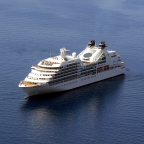
This new venture was to be on the almost brand-new Seabourn Quest.  We were attracted to the Quest (and the Seabourn line) for several reasons:

  1. The route and destinations of the cruise. This was paramount. We weren’t taking a cruise simply to take a cruise. We were taking a cruise because it was transportation and accommodation combined, for places we’d always wanted to visit. We were in particular attracted by the fact that this cruise visited two Greek islands (Santorini and Corfu), Olympia, and two new countries, Montenegro (Kotor) and Croatia (Dubrovnik – another must-see in the region). I’ve already blogged about two of these destinations, here and here.  And we knew that, once we were off the ship, we could do our own thing when visiting these destinations.
  2. The size of the ship. I hate the idea of the huge ships, full of thousands of people milling about, and so with only 200 rooms, the Quest sounded about perfect. If it was a hotel, it would be a boutique hotel. A classy one. And it lived up to these expectations;  the public areas of the ship never felt crowded.
  3. The quality of the ship and its services. If we were going to turf out money for a week-long cruise, we wanted to enjoy the food and wine, and to feel comfortable in our cabin.  And then the reviews of the food and wine on the Seabourn line.  The rave reviews tempted us. Add to that my mild claustrophobia, and the fact that all cabins were suites with a window and (most with a) balcony made the Seabourn Quest sound just about perfect.
  4. Financial issues.  Seabourn yachts are all-inclusive, and tipping is not expected.  This was a bonus.  Yes, it was expensive, but it was good to know, upfront, exactly what the experience would cost us.  Besides, New Zealanders always find tipping – a practice unfamiliar to us – a bit stressful, so if we can avoid it, we will!

The beautiful Seabourn Quest. The other cruise lines’ ships dwarfed our little Quest.

By the time we were ready to board the Quest, we had been travelling for several weeks, moving on every few days, and we were getting a bit tired. The idea of unpacking only once, of having a base (albeit moving), of not having to debate where to find a restaurant for dinner every night, and of not having to worry about our wallets or currencies or tipping for the next week – it all sounded like bliss.  Plus, there was going to be bottomless champagne.  We like that.  And so excitedly, we boarded the Quest.

It started perfectly. The champagne was on ice in our room, and after the Sailing Away party – including champagne – we explored the ship and then retired to our cabin for, yes, more champagne. The sea was calm, our suite spacious and comfortable. We felt as if we were in a five-star hotel. And we were. Better in fact.

Our room as we arrived – champagne bucket waiting for us.

And we’re off!

The Sailing Away party – a little Love Boat-ish

The Restaurant (the main dining room) was one of the biggest surprises. I think we had expected something along the lines of a good standard hotel coffee shop. But we were wrong. Arriving at the entrance of the luxuriously, lusciously decorated restaurant, the waiter took my arm (perhaps to ensure that women in high heels don’t totter over if the ship lurches? or maybe just a gallant touch) and led us to our table for two. There was no pressure to eat in a group, and this worked perfectly for us. It was also both more refined but more relaxed than I had originally envisaged – formal nights were optional – which made my husband very happy!

Every night at The Restaurant we had an amazing, romantic three course meal, with excellent wine selected to match the food. If we didn’t like the wine, we could ask for something else. We never did. The food was superb, the service was immaculate. In fact, we used to watch the waiters – they were always alert to an empty water or wine glass, or dropped napkin, and they never stopped moving. Before we had boarded the ship, we had assumed we would eat in The Restaurant one or two nights, but then try the other more casual restaurants. Other than at lunch, we didn’t. We missed The Restaurant only one night, when we ate in …

The menu at Restaurant 2

… Restaurant 2. This was advertised – erroneously if you ask me – as a more casual experience. It was a smaller, specialty restaurant seating only 30 people, with fusion food, a menu designed by Charlie Palmer. Reservations were essential. It was a degustation menu, with some extraordinary food, service and wine once again, in much more intimate surroundings than The Restaurant.

The ride was smooth.  There was only one night and morning when the sea was a little choppy. The ship began to rock after dinner on our second night. I gulped, a bit nervous that I might get sea-sick. But the ship rocked me to sleep, blissfully. I wish I could sleep like that every night. Otherwise it felt as if we were gliding – the sea was so calm, the ship so smooth.

A smooth trip

When we had free time on the ship, we rested in our room, read on our balcony listening to the swish of the waves, visited the library/internet cafe (with the best coffee on board), sat outside on deck and watched the world go by,  watched movies (on deck and in our room), and visited a bar. The Observation Lounge was our favourite. Before dinner it was busy, with hors d’oeuvres, and a pianist as we watched the sun set. Champagne or cocktails. Such a difficult decision!

The Observation Lounge, our favourite place

In fact, it seemed as if we did nothing on the ship but eat and drink. This is actually quite an accurate assessment, because after breakfast in the morning – room service or out on the deck – we would leave the ship, returning for a very late lunch and to rest our tired feet before heading out again, returning later for a shower and dinner.

There was a large spa available for massages and beauty treatments, but a) these were quite expensive, and b) we didn’t really have time to indulge. In comparison, some of the older passengers rarely left the ship, and probably used it and the other ship facilities more than we did.  I heard one conversation – a man was asked if he had gone off the ship to visit Santorini, and he replied “No. We visited it 30 years ago. I don’t imagine it will have changed.” I was astounded – especially as I’d go back to Santorini like a shot!

I was a little nervous that the other passengers would all be elderly and retired, and that we would feel old before our time. And whilst we liked to think we were in the younger 10%, there were plenty of passengers younger than us, and very few noticeably elderly. In other words, we didn’t feel out of place, which was a relief. I did have a moment or two of discomfort when, during a party one evening, we watched all these 50 and 60-somethings dancing to the band. I wondered how they looked to the 20-30 year old staff members, and cringed.    They certainly looked happy though, and maybe that’s all I should worry about.

The highlight of my day was always in the late afternoon, when we would (usually) sail away from our destination. We would make our way up to the 10th floor deck, grabbing a glass of champagne from the Observation Lounge, and toast our luck as the ship began to move, a soft breeze cooling us. This was how we sailed out of Santorini, and has to be the best possible way to leave that island, gliding past the lava islands, watching the white-washed villages on the top of the caldera gradually fade and disappear, sipping champagne, happy together.

Leaving Santorini

That said, I also loved the mornings, arriving somewhere new!  We arrived in Santorini in the middle of the night, and when we awoke we discovered an amazing view from the room.  In Corfu and Dubrovnik, we floated slowly past the old town walls, amazed at this wonderful way to see a new town.  In Kotor, we rose early, standing out on the chilly deck, as the Quest manoeuvred its way through some narrow channels and past tranquil villages.  And in Croatia’s Tri Luke Bay, we found ourselves in a kind of watery moonscape, with not a wave nor breath of wind through non-existent trees.

Early morning arrival in Corfu

I lay in bed, as we floated past Dubrovnik’s walls

The way we first saw Dubrovnik

Eerie stillness early morning in Tri Luke Bay

On our last morning, we sailed into Venice. My husband and I rose early – we wanted to be out on deck as we arrived. By the time we got up to the 11th floor deck, the Quest was already making its way along the Riva degli Schiavoni. We were astounded how close we were to the shore – we saw the hotel we stayed in on our first visit to Venice in 1998, and could pick out all the major landmarks. Gliding along, in the hush of the early morning darkness, with the most amazing view of Venice, we knew how lucky we were, even as we felt sad we had to leave the ship we came to love so quickly.

Our view at breakfast before leaving the Quest in Venice

Posted by: Mali | April 30, 2012

P is for Prince Edward Island

I’ve always been an avid reader. Whilst life gets in the way now, as a child I used to devour books. I would become completely smitten with characters, and they would become my friends (or enemies), perhaps because I lived in the country and so didn’t have friends (or enemies) nearby. I would read books over and over again, simply because we could only get into town to visit the public library once a week, and for some reason children were only allowed two books out at a time. Sometimes I’d finished my first book by the time we got home. One of my favourite books, then series, was Anne of Green Gables. So when I knew I had to go to the eastern states of Canada for business, I knew that a visit to Prince Edward Island was compulsory.

It was May, and the cold wind and rain we had endured in freezing Quebec City turned into bright sunlight and warm spring temperatures as we got off the overnight train at Monckton and picked up our rental car. We drove across the bridge to the island, and instantly felt at home. The landscape was gentle, with green farmlands, quaint (to our eyes) farm buildings, rolling hills, and lots of white, steepled wooden churches. There was a softness to the landscape, the light. There were no harsh edges and, as we drove into Charlottetown, with wide streets, few cars, leafy trees and elegant if a little tired buildings. The waterfront and historic area was nicely developed – not too busy, not too quiet, enough historic areas balanced with enough shops and restaurants to keep us interested, fed and watered. I felt a little like Goldilocks – it was all “just right.”

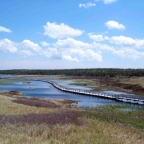
The next day we ventured out to explore the island. The weather was stunning, and this early in the season, we felt like the only travellers around. We headed to the north of the island, to one section of the Prince Edward Island National Park, in Greenwich. I’d seen a photo of this area before we left home, and thought it would be nice to visit. We went prepared for a hike of a couple of hours, and spent the first half of the time walking through what seemed like farmland on the edge of a forest, with hawks or eagles flying high above us.  I felt a momentary sadness, thinking of my father who had died only 8 or so months before, who would have revelled in the sight, but decided to revel in it for him.  After making our way through the coastal edge of the forest, we saw a marshlands spread out before us, and made our way across the boardwalk. At the end of the boardwalk, we climbed the sand dunes and walked along the endless sandy beach. We were the only people for miles, and it felt as if we were in the middle of the Atlantic, as remote as we could get.

Our time in Canada had been a little frustrating. We both like to know and understand the history of a place. But in Canada, we’d struggled to learn this. The more we saw, the more questions we had, realising how little we knew of this country that in some ways felt so familiar and so comfortable to us. In Montreal and Quebec, there was common reference to the trappers and the fur trade, but we actually had to ask someone at a museum what animals were actually providing the fur they had displayed! References to the indigenous populations were rare. But at the Charlottetown Founders’ Hall we found ourselves in a beginner’s guide to Canada, in what is often called the birthplace of Canada, and finally had some of our questions answered. I’ve read some scathing reviews of the Founders’ Hall, but suspect these were from Canadians themselves, who didn’t need the introductory version of their history and federation.

Of course, there was one key place we hadn’t yet visited, and so travelled back to the northwest of the island to make a pilgrimage, for me at least, to the home of cousins of Lucy Maud Montgomery, author of Anne of Green Gables. This house was the setting for the Green Gables of the books, and is decorated in the style of the times, and with features from the books. I was childishly delighted to see a brown dress hung in “Anne’s” room, remembering the dress from the book. (My husband was bemused at this pilgrimage, and to keep my dignity I had to continually remind him that “yes, I did know it was a piece of fiction.”)

We were lucky to be there in early May. The car-park was huge, and there were dozens of parks for tourist buses. As we arrived, a bus full of Japanese tourists – apparently huge fans of the books – was leaving. It made me smile – that a small girl voraciously reading a book in the South Island of New Zealand could have this in common with a small Japanese girl in bustling Tokyo, or indeed from anywhere all over the world.

That really summed up Prince Edward Island for me. It made me smile … and still does.

Posted by: Mali | April 16, 2012

O is for Oia

Oia is perched on the edges of the caldera

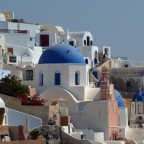
There are some places in the world that you dream about visiting; where a single picture  produces a sigh of yearning.  For me, the Greek island of Santorini has always been one of those places, and was therefore a compulsory stop on our trip last year to the eastern Mediterranean.  The photographs of the white-washed buildings, the blue church domes, and the sea and sky merging in the background have always produced in me an intense longing.  Those famous photographs are of the town of Oia (pronounced Ee-ah), perched high on the cliffs of the collapsed caldera, the remnants of a volcanic explosion.

Now, having visited Oia, I still sigh at the photographs, but I can also smile and remember.  The yearning still remains  – though not as strong – and so I have added the town to my list of places where I would like to spend a month or two one day, simply to write, read, relax, and enjoy.  Though preferably not in the heat of summer.

I will let the pictures speak for themselves:

Private churches - erected by families to saints to protect their seafaring loved ones - abound in Santorini.


Even a local bar - with refreshing cool drinks - had spectacular views.

Windmills were traditional, but are now quaint houses

The ubiquitous blue domes of Oia

Oia from the main town of Thera.

Older Posts »

Categories

Follow

Get every new post delivered to your Inbox.